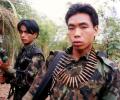
In an attack carried out by the armed militants of the ULFA-I a Hindi-speaking businessman and his daughter were killed in the interior Bijulibon area in Assam on Tuesday night.
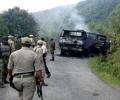
Nationalist Socialist Council of Nagaland-Issac-Munivah wanted to join the operations against NSCN-K militants.

The Centre should focus on achieving peace either through long-term ceasefire agreements or sustained military operations. Military operations which are just intermittent responses to particular incidents won't lead anywhere, says Devanik Saha.
Records stretching back to 1947 suggest a consistent strategy by Pakistan's military and intelligence apparatus, the Inter Services Intelligence (ISI), of using terrorism as a state policy against India.
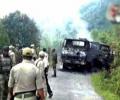
The newly-formed common forum of Northeast insurgent groups based in Myanmar has posed a renewed threat to security and peace in the troubled region.

Chief of Defence Staff General Bipin Rawat on Saturday said that China's ambitions and aspirations to global power presented an 'omnipresent danger' to stability in South Asia.

Nationalist Socialist Council of Nagaland-K leader S S Khaplang, whose outfit carried out the June 4 attack on the Army in Manipur, is believed to be ill and convalescing in a Yangon hospital.

Rediff.com gives you a lowdown on the NSCN-K.
After the Naga leader's death, Chinese intelligence may ensure ULFA terrorist Paresh Barua takes over as leader of the anti-India rebel groups operating out of Myanmar, says Nitin A Gokhale.
Rijiju said the central government will rehabilitate all Indian citizens in the Naga group if they abjure violence.

'After a strategic pause though, Beijing will revive its policy of slowly creeping towards acquiring sovereignty over the South China Sea.'

The operation in Nagaland and Manipur was carried out after the army received "credible and specific" intelligence.
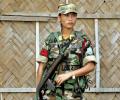
Naga rebel groups remain divided over the pact. Moreover, secrecy on accord creates apprehension in the society. K Anurag reports

An aggressive Pyongyang is likely to force Seoul and Tokyo to build nuclear deterrents and thus thwart Beijing's ambitions.

Bearing in mind how full India's pitcher is with ethnic and communal complexities, only the greatest circumspection can hold this country together in a willing union.
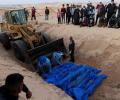
India's voting pattern in the United Nations with regard to the Israel-Palestine conflict is lately marked by a calibrated distancing from Israel, observes Ambassador M K Bhadrakumar.
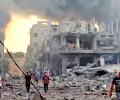
India is one of the few countries in the region that enjoys good relations with both Israel and Saudi Arabia, and IMEC would allow it to recreate the old Spice Route to Europe. All this is in jeopardy now, notes Rajeev Srinivasan.

China is engaged in hotly contested territorial disputes in the South and East China Seas. Beijing has also made substantial progress in militarising its man-made islands in the past few years, which it says it has the right to defend.

Manipur needs an integrated politico, military, socio-economic approach, says Sanjeev Nayyar.
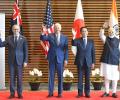
India has the ability in all respects to be a great power and address our security challenges in the best national interests, says Commodore Venugopal Menon (retd).
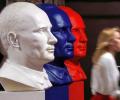
'But Russia is well aware of Pakistan's nuisance power on its border.'

'An isolationist US and a disintegrating European Union will create a power vacuum that only China is in a position to fill -- a conclusion that is uncomfortable but unavoidable,' says Nitin Desai.

The India-Japan joint naval exercises are a strategic signal for China, observes Dr Rajaram Panda.

Darryl D' Monte, the distinguished enviromental journalist, discusses how the media covers floods in Mumbai or Texas, but ignores Assam or Bangladesh.

'He was always opposed to a form of nationalism that was narrow, selfish and arrogant.' 'He will always remain a beacon of inspiration for freedom-loving people across the world and for movements of resistance against oppressive State power.'

'There is no Buddha or Gandhi among countries, existing for the service of others; they all exist for the good of themselves.' 'For each country, its own interests should be paramount, and it is futile and churlish to expect China to be an exception to this rule,' says B S Raghavan, the distinguished civil servant and long-time China-watcher.

'For a long time Pakistan dreamt that India would break up and that it would be the predominant power in the region,' says Colonel Anil A Athale (retd).

'The US wants Modi to succeed because we want India to succeed. For our part, when India thinks of its partners in the world, we want it to think of the US first. That means positioning our country as the preferred provider of the key inputs that can help to propel India's rise.' 'The meeting between Modi and Obama is, and must be, an opportunity for true strategic dialogue -- not a scripted exchange of talking points, but an open discussion of the big questions. What kind of world do we want to live in? What are our true priorities? And most importantly, why does this partnership still matter?'

'Chinese leaders rarely receive their foreign guests in cities other than Beijing. Such respect for India!' 'Does it mean that Modi could replicate "the warmth and unconventional way" by sending Indian troops into Tibet, as Xi did in Chumur (Ladakh) when he arrived in India? Of course, Indians are far too polite to do so,' says Claude Arpi.
If the aim is to become a player with some strategic space of its own, not just in the Indian Ocean region but also in the adjoining region, then greater interaction with China is desirable, even necessary.

The decision to not attend the forum attended by 28 heads of state and 130 national delegations is a clear break from its usual policy of going along with the crowd.

'So a number of people are drawn in along with members of their friends' circle or their relatives.' 'A number of individuals find that they have more in common with the 'imagined community' that they discover online as opposed to their own physical community and indeed, even the majority Muslim community elsewhere.'

The soul of India resides in pluralism and tolerance. This plurality of our society has come through assimilation of ideas over centuries. Secularism and inclusion are a matter of faith for us. It is our composite culture which makes us into one nation.

'India was in no position to wage another war in 1965, having suffered a morale-shattering defeat in 1962. The three services were in the middle of a modernisation and expansion phase and therefore not fully trained or battle-ready.'

'It is in the interest of both sides that the visit of the US President is seen as being successful. Both sides have invested considerable political capital in it. This rapid exchange of visits and the decisions taken have to be justified, beyond the symbolism, which is no doubt important in itself. This opportunity to impart a fresh momentum to ties should not be missed,' says former foreign secretary Kanwal Sibal.

'Whether it's investments in Kashmir, building naval facilities, or selling top-of-the-range military equipment, Pakistan could well benefit more under Xi's watch.' 'Do Chinese concerns about the 'Islamisation' of Pakistan give it pause about how quickly to move forward with security and economic projects? At the moment the indication is quite the opposite: China is doubling down on its support to Pakistan, partly because of its fears about where the country is headed.'
